


Oxaloacetic Acid (OAA): The Cellular Energy Molecule Powering Mitochondrial Health
- Nov 2, 2025
- 3 min read
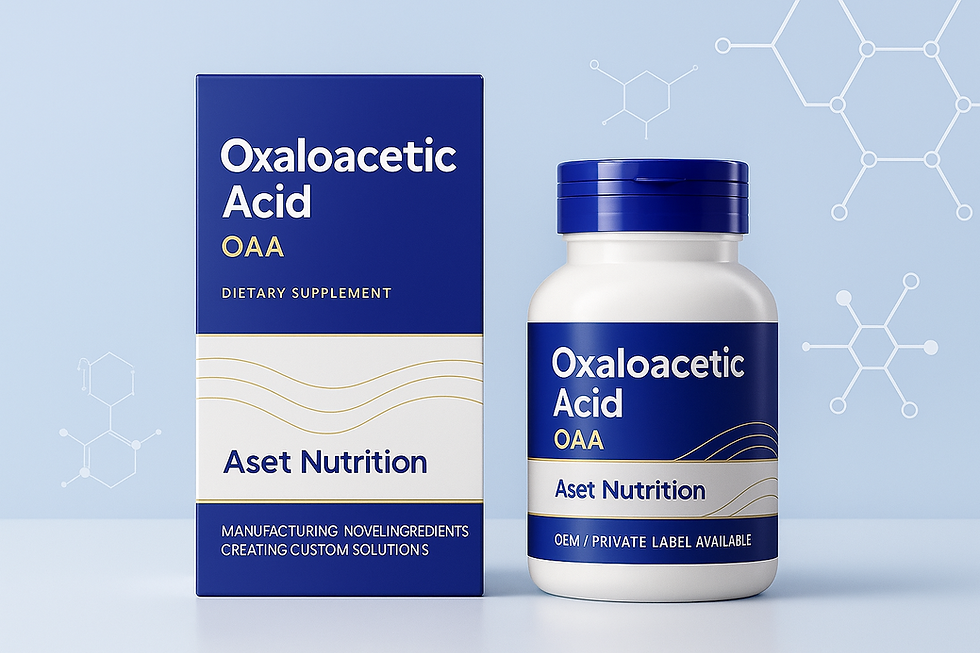
In the pursuit of better energy, longevity, and cognitive resilience, Oxaloacetic Acid (OAA) has re-emerged as one of the most exciting biochemical compounds in modern nutritional science.
At Aset Nutrition, we view OAA not just as a supplement ingredient — but as a metabolic catalyst that directly supports mitochondrial efficiency and cellular repair.
🔬 What Is Oxaloacetic Acid (OAA)?
Oxaloacetic Acid is a naturally occurring metabolic intermediate in the Krebs Cycle (also known as the Citric Acid Cycle) — the core biochemical pathway that converts nutrients into usable cellular energy (ATP).
It plays a central regulatory role in energy metabolism, linking carbohydrate, fat, and amino acid pathways.
Chemically, OAA is a four-carbon dicarboxylic acid with the formula C₄H₄O₅. In living systems, it interconverts with malate via the malate dehydrogenase enzyme, a process that helps shuttle electrons and reduce oxidative stress within mitochondria.
⚙️ How OAA Works in the Body
1.
Mitochondrial Energy Production
OAA acts as a substrate in the Krebs Cycle, which is responsible for producing over 90% of cellular ATP.
When OAA levels decline — due to aging, stress, or poor nutrition — energy metabolism slows, leading to fatigue, brain fog, and reduced vitality.
Supplemental OAA helps restore the efficiency of mitochondrial turnover and stabilizes NAD+/NADH balance, essential for sustained energy release.
2.
Neuroprotection and Cognitive Support
Research has shown that OAA can cross the blood-brain barrier and exert neuroprotective effects.
It helps reduce glutamate toxicity — one of the main drivers of neuronal damage and aging-related cognitive decline.
Animal and pilot human studies suggest potential applications for conditions related to memory, focus, and neuroinflammation.
3.
Anti-Fatigue and Recovery Enhancement
By supporting ATP generation and oxidative balance, OAA may delay muscle fatigue and accelerate post-exercise recovery.
Athletes and individuals with high cognitive workloads benefit from its ability to stabilize energy output without stimulating the central nervous system — unlike caffeine or nootropics.
4.
Longevity and Anti-Aging Potential
Emerging data indicates that OAA mimics certain effects of caloric restriction — one of the most studied interventions for lifespan extension.
It activates similar metabolic pathways related to AMPK signaling, mitochondrial biogenesis, and redox homeostasis.
In this sense, OAA represents a bridge between energy metabolism and longevity research.
🧪 Scientific Evidence and Research Highlights
Mitochondrial Enhancement:
Studies from the University of California have demonstrated that OAA supplementation enhances mitochondrial respiration and protects neurons from oxidative damage.
Neurodegenerative Models:
Preclinical research has shown that OAA improves behavioral outcomes in animal models of Alzheimer’s and Parkinson’s disease through neuroinflammation control.
Metabolic Regulation:
OAA influences glucose metabolism and insulin sensitivity, suggesting potential as a metabolic modulator for individuals with mild metabolic disorders.
While clinical validation in humans is ongoing, early-stage data strongly supports OAA’s multifunctional role in maintaining cellular vitality.
🧬 Aset Nutrition’s High-Stability OAA
One of the main challenges with Oxaloacetic Acid is its chemical instability — it easily decarboxylates into pyruvate during storage or exposure to heat.
Aset Nutrition’s R&D team has developed a proprietary stabilization process to ensure purity, potency, and bioavailability:
Stabilized crystalline OAA with >98% assay purity
Controlled particle size for improved absorption
Produced under ISO and cGMP-certified conditions
Verified by HPLC and LC-MS analytical methods
Our OAA is suitable for use in capsules, tablets, powdered blends, and functional beverages, making it versatile for both nutrition and performance markets.
💡 Applications
Category | Function | Example Formulation |
Energy & Performance | Boosts ATP, reduces fatigue | OAA + CoQ10 + Magnesium |
Brain Health | Supports cognitive clarity, reduces oxidative stress | OAA + Alpha-GPC + DHA |
Longevity & Anti-Aging | Activates AMPK, mimics caloric restriction | OAA + NMN + Resveratrol |
Metabolic Balance | Enhances glucose control and lipid metabolism | OAA + OEA + Chromium Picolinate |
🌍 Why OAA Matters for the Future of Nutrition
As global consumers seek clean, effective, and scientifically credible ingredients, OAA fits perfectly into the “smart energy” and “longevity nutrition” paradigm.
It’s not just an energy booster — it’s a metabolic optimizer, supporting the body’s most fundamental biochemical systems.
By addressing mitochondrial decline — the root cause of aging, fatigue, and metabolic imbalance — OAA aligns with the next decade’s wellness priorities: precision, prevention, and performance.
⚙️ Key Specifications
Property | Specification |
Chemical Name | Oxaloacetic Acid |
Assay (HPLC) | ≥98% |
Appearance | White crystalline powder |
Solubility | Soluble in water and ethanol |
Stability | Stabilized form, extended shelf life |
Packaging | 1kg aluminum foil bag / 25kg drum |
🏁 Conclusion
Oxaloacetic Acid (OAA) represents the convergence of biochemistry, neuroscience, and longevity science.
By revitalizing mitochondrial function and protecting against oxidative stress, it supports both energy and endurance — at the cellular level.
At Aset Nutrition, we provide high-stability, pharmaceutical-grade OAA for brands seeking next-generation formulations backed by real science.
From cellular energy to cognitive clarity — OAA powers the future of human performance.


